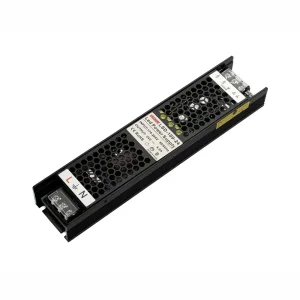
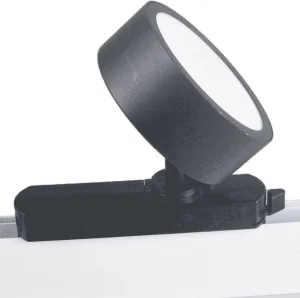
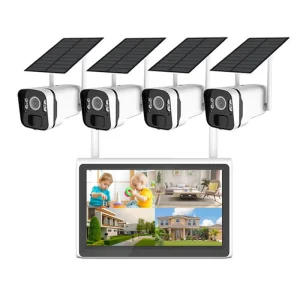
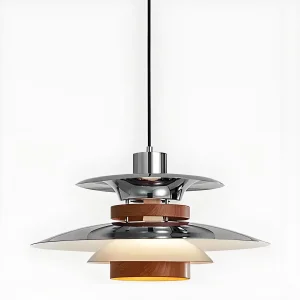
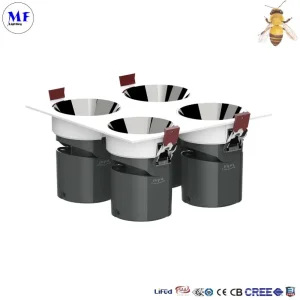
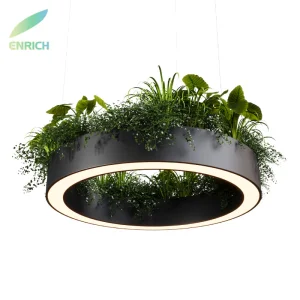
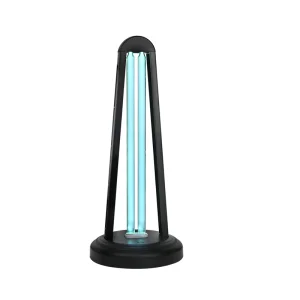
Explore our elite selection of commercial drivers, intelligent monitoring nodes, and premium lighting components engineered for flicker-free reliability.
Temporal Light Artifacts (TLAs) refer to unwanted fluctuations in light output that affect human visual perception. Historically neglected during the incandescent and fluorescent lighting eras, TLAs have emerged as a critical concern with the rapid deployment of high-frequency LEDs. TLAs manifest as three distinct phenomena: visible flicker, stroboscopic effect, and the phantom array effect.
These fluctuations are primarily caused by the power electronics governing the current delivery to the LEDs. Traditional AC-to-DC rectification cycles often induce a residual alternating current (ripple current) at twice the grid frequency (typically 100Hz or 120Hz). Direct current ripple translates into proportional variations in lumen output, causing significant visual fatigue, performance degradation, and adverse health effects in residential, commercial, and industrial environments.
To evaluate these artifacts, international regulatory bodies have established metrics such as Pst LM (Short-Term Flicker Indicator) and SVM (Stroboscopic Visibility Measure). Standard IEEE 1789-2015 outlines the safe limits of modulation to minimize biological impacts, classifying parameters into "No Effect" and "Low Risk" levels across various operating frequencies. Modern solid-state luminaires require flicker-free technology to meet standards like California Title 24 and European EcoDesign regulations.
IEEE 1789 Compliance Metrics
Flicker index (< 0.08) and modulation percentage (< 8% at 100Hz/120Hz) are critical benchmarks for architectural, medical, and photographic lighting installations. A high-efficiency, dual-stage ripple suppression driver is required to achieve these levels.
Awarded the prestigious China National High-Tech Enterprise certification in 2021, Ningbo Gravity Light Manufacturing Co., Ltd. brings over 20 years of expertise in Gravity Light packaging and semiconductor innovation. We focus on high-end Gravity Light COB technology, custom PCB design, and advanced driver topologies to position ourselves as a leading exporter of premium light sources.
We work to establish partnerships that drive technological advancement across the lighting industry. Operating under a strict "High Quality, Zero Defect" production standard, we manage quality controls across our entire supply chain—from raw silicon wafer selection to thermal testing of assembled modules. Our production lines combine automated surface-mount technologies (SMT) with custom optoelectronic calibration to deliver reliable lighting solutions.
Discover how our engineered solutions, compliance frameworks, and global logistical support can optimize your solid-state lighting systems.
We provide custom design options for diverse applications, including bi-color arrays, aerial drone systems, marine aquaculture, high-speed photography, and smart network nodes.
Our products comply with international testing protocols. Our configurations carry RoHS, CE, ETL, KC, PSE, and UL approvals to simplify market entry.
Our distribution channels and supply chain integrations ensure reliable transport across North America, Europe, Asia-Pacific, and South America.
Collaborate with our application engineers. We provide ongoing consulting, PCB Gerber reviews, and simulation services to accelerate project implementation.
Understanding the engineering tradeoffs behind solid-state lighting driver architectures.
| Driver Architecture | Flicker Performance (SVM / Pst LM) | Efficiency Range | Dimming Capability & Performance | Ideal Applications |
|---|---|---|---|---|
| Single-Stage without PFC | Poor (SVM > 1.2, Pst LM > 1.5) | 80% - 85% | Limited, high risk of low-frequency dimming flicker. | Basic indicators, cost-sensitive residential setups. |
| Single-Stage with Ripple Filter | Moderate (SVM 0.4 - 0.7, Pst LM 0.8 - 1.0) | 82% - 87% | Standard Triac/0-10V, moderate dimming range. | Standard commercial lighting, architectural retrofits. |
| Two-Stage with Active Ripple Minimization | Excellent (SVM < 0.05, Pst LM < 0.1) | 88% - 94% | DALI-2, Push-Dim, 0-10V, smooth PWM-to-Analog down to 0.1%. | Medical surgical suites, high-speed camera studios, offices. |
| Resonant LLC Converter with Linear Post-Regulators | Superior (Practically 0, SVM = 0) | 90% - 95% | High-resolution digital dimming with zero phase-shift noise. | High-power industrial operations, sports venues, broadcast studios. |
To eliminate temporal anomalies, our engineering team designs two-stage driver topologies. The primary stage is dedicated to achieving a high Power Factor (PF > 0.98) and low Total Harmonic Distortion (THD < 8%) through an active power factor correction (PFC) boost converter. The secondary stage utilizes a buck converter or a resonant half-bridge topology to output a stable direct current, decoupling the output LED current from the input AC line frequencies.
Furthermore, we incorporate active ripple filters using metal-oxide-semiconductor field-effect transistors (MOSFETs) controlled by precision feedback loops. This system dynamically absorbs voltage fluctuations before they reach the LED junction, ensuring a smooth current output under varying thermal conditions and loading environments.
How zero-flicker technology supports demanding operating environments around the world.
Continuous exposure to low-frequency light modulation can cause sub-conscious eye strain, headaches, and a decline in cognitive performance. Implementing certified flicker-free drivers in commercial office spaces support ergonomic standards and improve occupant well-being.
In facilities utilizing rotating tools or high-speed machinery, stroboscopic effects can create optical illusions where moving equipment appears static or slow-moving. Eliminating TLAs is critical to maintaining safe operating environments for industrial workers.
High-speed cameras capture video at hundreds of frames per second. Even minor current fluctuations can display as dark horizontal bands across video feeds. Our driver technology maintains consistent performance under high-speed capture conditions.
A projection of advanced solid-state lighting and smart power conversion over the next decade.
Replacing traditional silicon MOSFETs with Gallium Nitride (GaN) transistors allows for higher switching frequencies (up to 1MHz). This enables a reduction in magnetics and filter sizes while improving overall driver efficiency.
Integrating low-power microcontrollers allows drivers to dynamically adjust switching parameters based on thermal cycles, real-time dimming commands, and system aging variables, maintaining zero-flicker operation over time.
Modern architectures incorporate bidirectional wireless communications (Thread, Bluetooth Mesh, Zigbee) and DALI-2 protocols directly into the driver stage, facilitating smart building integration and automated maintenance alerts.
Technical answers to key questions about modern solid-state lighting architectures.
LEDs are current-driven devices that react almost instantly to changes in input current. If the output current from the driver contains an AC ripple component (typically resulting from 50Hz/60Hz rectifications), the LED will cycle in lumen output at 100Hz/120Hz, creating visible or invisible flicker.
Our solutions address this by implementing a two-stage driver topology. The first stage uses active Power Factor Correction (PFC) to clean the AC mains input, while the second stage uses a DC-DC converter to regulate current, reducing current ripple and mitigating stroboscopic effects.
IEEE 1789-2015 provides guidelines for evaluating LED flicker at various frequencies. It defines limits for percent modulation (Flicker%) to protect human health. For example, at a frequency of 100Hz, the maximum allowable percent modulation for "low risk" is 8%, and for "no effect" is 3%.
At higher frequencies (e.g., above 1.25kHz), the eye cannot detect stroboscopic effects, allowing for higher modulation percentages. Our premium drivers maintain modulation levels well below the "no effect" threshold across their entire operating ranges.
Triac dimming cuts portions of the AC waveform, which can introduce electrical noise and increase flicker risk at low dimming levels. 0-10V and DALI dimming use control signals to adjust driver output, typically avoiding direct modification of the AC supply.
To ensure flicker-free dimming, our drivers convert dimming signals into high-frequency PWM or linear analog current reduction, maintaining clean current delivery across the entire dimming range.
Many animals and plants have different temporal visual resolutions than humans. For example, avian species can perceive flicker at frequencies up to 100Hz to 150Hz. Unfiltered flicker in agricultural settings can cause chronic stress, behavioral issues, and reduced growth rates.
In horticultural applications, stable current delivery prevents operational stress on photosynthetic mechanisms under high-intensity artificial light profiles, supporting optimal growth cycles.
In the EU, the Ecodesign Directive (Single Lighting Regulation) enforces strict limits on SVM (≤ 0.4) and Pst LM (≤ 1.0) under full load conditions. In North America, ENERGY STAR® and California Title 24 Joint Appendix 8 (JA8) define similar flicker measurement protocols.
All our exported systems undergo certified laboratory testing to verify compliance with these global benchmarks, ensuring smooth custom approvals and market integration.
Explore our line of specialty components, medical-grade modules, and sustainable municipal infrastructure solutions.
Ningbo Gravity Light Manufacturing Co., Ltd. serves a diverse global client base. Our engineering designs and products are regularly exported to regions including the United States, Vietnam, Japan, Great Britain, Italy, Russia, India, Brazil, Spain, and the Middle East.
 Gravity Light