Advanced modules engineered for architectural spatial tuning, featuring low-drift spectral outputs and dynamic human-centric color rendering.
In modern lighting architecture, color theory is not merely an aesthetic choice; it is an exact discipline rooted in visual physics, thermodynamics, and optical engineering. When architectural firms, project developers, and municipal planners in regions like Naples evaluate lighting suppliers, their primary challenge is to maintain spectral consistency under demanding ambient conditions. Realizing the full potential of color theory requires a deep understanding of three critical variables: Correlated Color Temperature (CCT), Color Rendering Index (CRI), and TM-30 metrics.
CCT, measured in Kelvin (K), characterizes whether a light source appears warm (e.g., 2700K), neutral (e.g., 4000K), or cool (e.g., 6500K). However, CCT alone is insufficient. Two luminaires can share an identical CCT of 4000K yet display vastly different visual profiles—one casting a greenish tone and the other a purplish tone. This variation is governed by Duv (the distance from the Planckian Locus in the CIE 1960 color space). A positive Duv yields a green tint, while a negative Duv results in a red/pink tint. Ningbo Gravity Light Manufacturing Co., Ltd. solves this through rigorous MacAdam Ellipse binning (typically maintaining a 3-step or 2-step SDCM), ensuring that variations in chromaticity remain virtually imperceptible to the human eye across large-scale installations.
Moving beyond the simple Ra index, we use the TM-30 method with 99 Color Evaluation Samples (CES) to precisely evaluate Fidelity ($R_f$) and Gamut ($R_g$) to avoid color distortion.
Our packaging processes deliver color-point stability down to a 3-step SDCM, preserving color uniformity across long run lengths, high ambient heat, and aging cycles.
By balancing phosphors at the semiconductor packaging stage, we customize SPDs to deliver optimal blue-light mitigation and high-efficiency outputs.
For decades, CRI ($R_a$) served as the standard metric for assessing color quality. However, because it only calculates the average rendering of eight low-saturation pastel colors ($R_1$ to $R_8$), it frequently misrepresents saturation levels—especially in deep reds ($R_9$). In architectural restorations and retail environments in Naples, rendering vibrant reds and natural skin tones is crucial. Consequently, our engineering team utilizes the newer TM-30-18 standard. This standard provides two key indices: the Fidelity Index ($R_f$, scale 0–100) and the Gamut Index ($R_g$, scale 60–140), offering a much more accurate evaluation of color rendering and saturation levels.
Naples, with its unique architectural heritage and coastal setting, presents distinct challenges for commercial and municipal lighting projects. Designing systems for this region requires balancing aesthetic preservation, environmental protection, and resilience against demanding weather conditions.
Lighting installations in Naples must withstand high humidity, coastal salinity, and elevated temperatures. Salt spray accelerates the degradation of housing materials and optical lenses, leading to color shift and reduced lumen maintenance. To address this, our fixtures feature marine-grade, die-cast aluminum alloys treated with anti-corrosion, powder-coated finishes (compliant with ISO 9227 salt spray testing), alongside UV-stabilized polycarbonate or tempered glass optics. This ensures that the color rendering index and light output remain stable throughout the system's operational lifespan.
Coastal developments must also strictly adhere to environmental regulations, including turtle-friendly lighting standards and Dark-Sky compliance. Traditional cool-white LEDs (high in blue-wavelength light) disrupt local wildlife, particularly nesting sea turtles and migratory birds. To mitigate this, we develop custom, narrow-band amber luminaires (590nm–610nm) and warm-white fixtures (under 2700K) with zero uplight (U0 rating). These configurations minimize ecological disruption while providing functional illumination for coastal paths, walkways, and hospitality venues.
Naples' historic plazas, historic structures, and residential facades require lighting that complements their architecture. Using high-CRI (95+), low-temperature warm-white lighting preserves the character of natural stone, terracotta, and historical facades. This color profile replicates the warm, inviting glow of traditional incandescent sources while delivering the efficiency and longevity of modern LED systems.
High-reliability elements designed to integrate seamlessly into complex architectural projects, commercial developments, and industrial systems.
High-performance lighting projects require a dependable manufacturing partner. As a certified National High-Tech Enterprise, Ningbo Gravity Light Manufacturing Co., Ltd. combines advanced R&D with a highly optimized supply chain to support projects worldwide, including in the Naples region.
Our manufacturing capabilities are built on over 20 years of experience in LED packaging and semiconductor development. We manage the entire production cycle, from raw wafer selection and wire bonding to phosphoring and final quality control. This vertical integration allows us to achieve precise binning and consistent thermal management across our products.
Operating out of Ningbo, China, gives us access to a world-class electronics and raw materials ecosystem. This logistical advantage allows us to offer competitive lead times, efficient prototyping, and highly cost-effective customization compared to regional suppliers. Additionally, our optimized global shipping routes ensure smooth customs clearance and on-time delivery directly to project sites in Naples.
Figure 1: Automated LED packaging line and spectral testing facilities at Ningbo Gravity Light.
We implement a comprehensive quality management system at every phase of design, component sourcing, and assembly. Every production batch undergoes rigorous testing, including thermal stress cycling, IP66/IP68 water immersion tests, and integrating sphere analysis. This data-driven quality control helps prevent early-stage diode failures and color shift, ensuring reliable long-term performance.
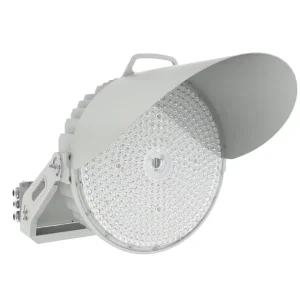
Industrial-grade floodlights and municipal fixtures engineered for high thermal performance, extreme weather resilience, and precise optical control.
Navigating global procurement requires adhering to strict international standards. At Ningbo Gravity Light, our products meet international certification requirements to ensure safety, reliability, and regulatory compliance across diverse target markets.
Our designs are tested and certified to comply with major global standards, including RoHS, CE, ETL, KC, and PSE. This certification process guarantees that our fixtures meet environmental safety, electromagnetic compatibility, and electrical safety standards required for installation in different regions. Additionally, our utility patent for a System-level Integrated Lighting Module demonstrates our commitment to developing robust and efficient thermal-electrical architectures.
We provide comprehensive OEM/ODM engineering services to customize fixtures for specific project demands. Our capability covers custom PCB layouts, bespoke thermal management systems, and specialized color formulations. Whether you require precise color rendering for retail displays or durable, sea turtle-friendly amber lighting for coastal applications, our technical team works closely with you from initial prototype through to volume production.
Direct technical answers from our R&D engineering team on color consistency, product specification, and project logistics.
We use automated MacAdam Ellipse binning (3-step SDCM standard, with 2-step options for sensitive interior applications). By directly controlling the phosphor formulation at the chip-on-board packaging stage, we manage spectral distribution tolerances, minimizing color temperature shift across large-scale installations.
Yes. We engineer specialized narrow-band amber luminaires (590nm to 610nm range) that do not emit the blue wavelengths that disrupt sea turtles and other coastal wildlife, while providing safe illumination for walkways and beachfront areas.
Standard design configurations are processed in 15–20 days, while custom OEM/ODM projects requiring new tooling or custom PCBs generally take 30–45 days. We coordinate directly with freight forwarding networks to ensure efficient delivery through to your designated destination port or project site.
Our outdoor luminaires feature marine-grade, die-cast aluminum housings, stainless steel hardware, and TGIC polyester powder coat finishes. The optical chambers are sealed to IP66 or IP67 ratings, protecting the LED modules and optical components from moisture and salt intrusion.
Yes. We provide complete TM-30-18 spectral reports, including the Fidelity Index ($R_f$), Gamut Index ($R_g$), and color vector graphics, helping lighting designers verify color rendering performance prior to installation.
Contact our engineering and design team to discuss your project specifications and receive technical support.
 Gravity Light