What is the best light spectrum for growing succulents indoors? For most home growers, a bright, full-spectrum white LED is a practical starting point. It supplies a broad mix of visible wavelengths, rather than relying on a strong blue or red glow alone. Many succulents grow compactly when light is bright enough, while insufficient light can leave stems stretched and leaves spaced farther apart. A suitable spectrum helps, but it cannot compensate for weak intensity.
Plant physiologist Dr. Bruce Bugbee studies how light affects plant growth. A fair paraphrase of his guidance is: “Spectrum matters, but intensity and daily exposure matter more than a bulb’s color label.” That distinction is useful. Look for a light with clear specifications, and consider its distance from the plants and daily operating time. A lamp’s advertised wattage alone does not show how much usable light reaches a particular pot.
Watch the plants closely. New growth that becomes unusually elongated may suggest the light is too weak; pale, scorched patches can signal excessive exposure or a sudden change. Move lights gradually, since even sun-loving succulents can react poorly to abrupt shifts. There is no single perfect setting for every species, shelf, or season. That part takes observation. Start with a moderate schedule, check growth over several weeks, and adjust carefully. The result may be less tidy than a chart promises, but your plants provide useful evidence.
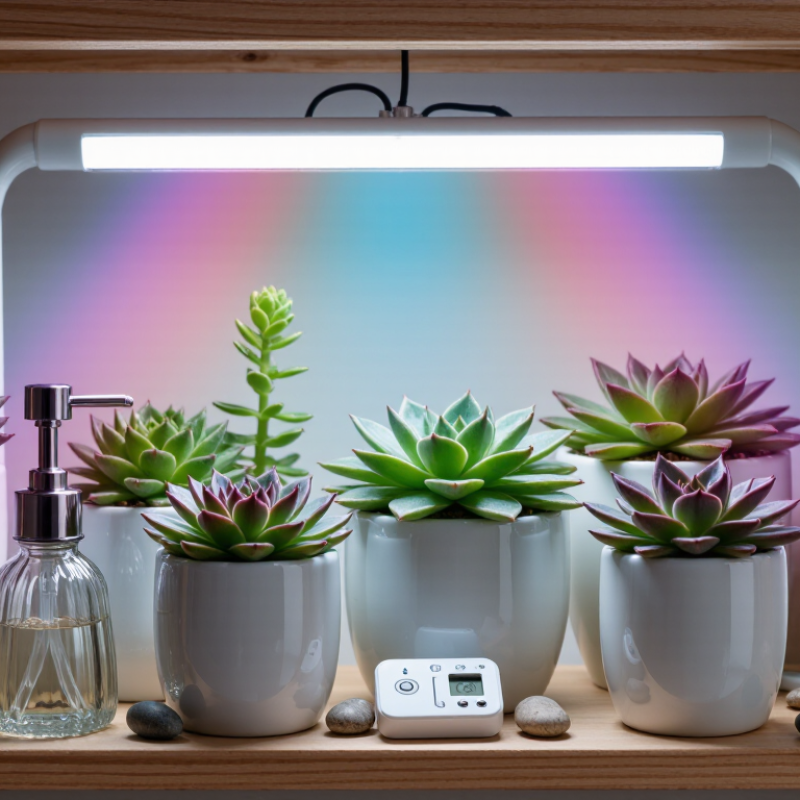
Succulents use a broad range of visible light, roughly 400 to 700 nanometers, for photosynthesis. Blue wavelengths support compact leafy growth, while red wavelengths also contribute to growth and flowering. In practice, a balanced, full-spectrum white light is often easier to use than a narrow-color lamp. Color can mislead. A purple glow does not prove that a light provides enough usable intensity.
Light intensity matters as much as spectrum. A bright window may work for sun-tolerant types, but many indoor plants stretch when light is weak. With a grow light, keep the fixture close enough to provide strong light without heating leaves, then adjust gradually. Watch the plant. Long, pale growth can signal insufficient light; scorched patches or faded color may mean the light is too intense. A timer can provide a steady daily schedule, often around 12 to 14 hours, though species and fixture strength change what works. Dark winter rooms may need more help than sunny ones. I used to focus too much on the lamp’s color; checking growth over several weeks is a better guide. Some plants still respond unpredictably. A small change in distance can matter.
For indoor succulents, an effective grow-light spectrum usually combines blue and red wavelengths rather than relying on one color. Blue light, roughly 400–500 nanometers, helps support compact growth and sturdy leaves. Red light, around 600–700 nanometers, contributes strongly to photosynthesis and can influence flowering. A balanced, broad-spectrum white light is often practical because it supplies both ranges and makes it easier to notice changes in leaf color.
Spectrum is only part of the picture. Light intensity, daily exposure, and distance from the leaves matter just as much. A bright lamp placed too close can bleach or stress a plant; one placed too far away may encourage stretched stems. Watch the plant. Compact new growth is a useful sign, while leaning or unusually long gaps between leaves can suggest insufficient light. Increase exposure gradually, especially after moving a succulent from a dim windowsill. Give it time to adjust. I would not treat a wavelength chart as a precise recipe: species, season, and room conditions all shift the response, and that variability can be frustrating.
| Light band | Approximate wavelength | Plant response and practical value | Indoor growing guidance |
|---|---|---|---|
| Blue | 400–500 nm | Contributes to photosynthesis and helps regulate compact growth, leaf development, and stomatal responses. | Use as part of a balanced white or full-spectrum light. Strong blue light alone is not a substitute for adequate total light. |
| Green | 500–600 nm | Can support photosynthesis and penetrate farther into leaves and plant canopies than blue or red light. | A useful component of broad-spectrum lighting; there is no need to exclude green wavelengths. |
| Red | 600–700 nm | Efficiently supports photosynthesis and influences growth and flowering responses. | Red wavelengths work best alongside blue and other visible wavelengths rather than as a red-only source. |
| Far-red | 700–750 nm | Can affect shade-avoidance and flowering responses when combined with other light; its effects depend on species and intensity. | Not essential for routine succulent care. Avoid treating far-red alone as a complete growing spectrum. |
| Ultraviolet-A (UVA) | 315–400 nm | May influence pigmentation and protective responses, but results vary by species, dose, and growing conditions. | Not required for healthy indoor growth. Do not add UV exposure without a specific, carefully controlled reason. |
| Ultraviolet-B (UVB) | 280–315 nm | Can cause stress or tissue damage at excessive exposure; it is not a routine photosynthetic requirement for indoor succulents. | Generally avoid supplemental UVB in ordinary home setups. |
| Broad-spectrum white light | Usually spans much of 400–700 nm | Provides a practical mix of visible wavelengths for photosynthesis and makes plant condition easier to assess. | A quality white or full-spectrum grow light is a convenient starting choice; evaluate light intensity and duration as well as spectrum. |
Practical starting point: For many indoor succulents, begin around 100–200 µmol·m⁻²·s⁻¹ of PPFD at leaf level for 12–14 hours daily, then adjust gradually according to species and plant response. This corresponds to an approximate daily light integral of 4.3–10.1 mol·m⁻²·day⁻¹. Light needs vary; increase exposure gradually and watch for bleaching, scorching, stretching, or loss of color.
Indoors, spectrum matters, but intensity and timing often determine whether a succulent stays compact. A balanced, full-spectrum white light makes leaf color and new growth easier to assess than a strongly colored lamp. Blue wavelengths support compact growth, while red wavelengths contribute to photosynthesis; neither can compensate for insufficient brightness. Plants differ.
For many succulents, start with 10–12 hours of light daily, then adjust based on growth and the fixture’s strength. A timer helps keep exposure steady. Keep the plant’s natural dark period, and avoid leaving lights on around the clock. Place the lamp according to its instructions, since distance changes intensity sharply. A phone light-meter app can help compare positions, but it is not a precise substitute for a proper meter.
Watch the plant, not just the clock. Long, pale growth and widely spaced leaves can signal too little light; scorched patches may mean excessive intensity or a sudden change. Move plants closer or farther in small steps, and give them several days to respond. I have found this part less exact than guides suggest: window direction, glass, season, and species all complicate the picture. Rotate the pot occasionally, but do not expect every leaf to look identical.
Selecting a grow light is less about chasing a “succulent spectrum” and more about delivering enough usable light evenly. University of Minnesota Extension recommends 12–14 hours of supplemental light daily for many indoor plants. Start with a broad-spectrum white LED and use a timer to keep the schedule steady. Check the fixture’s photosynthetic photon flux density (PPFD) map at the height of your plants, not just its wattage. ANSI/ASABE S640 standardizes PPFD units, making readings easier to compare across lighting products.
Distance matters. Place the fixture roughly 8–12 inches above the tallest leaves, then adjust gradually; actual output varies by fixture and room. Keep the light centered over the pots, and rotate them weekly if growth leans toward one side. Pale, scorched patches can signal excessive intensity, while stretched stems often indicate too little light. Look closely after a week. Phone light-meter apps are imperfect, so treat their readings as rough clues, not precise measurements. A small distance change can help, but sudden changes may stress plants. I would record the setup and leaf changes; otherwise, it is easy to blame the spectrum when placement was the real problem.
A useful light setup is not a fixed recipe; watch how each succulent responds. Place a small-leaved plant near the growing area and photograph it weekly from the same angle. New growth that stretches toward the window, with wider gaps between leaves, often signals insufficient light. Pale, dry patches on the side facing the lamp may indicate excess intensity or a sudden change. Check soil moisture too, since stressed roots can mimic light problems. Small clues matter.
Measure light at leaf height, not on the shelf. Michigan State University Extension’s greenhouse guidance describes daily light integral, or DLI, and gives roughly 10–12 mol·m⁻²·day⁻¹ as a common range for many greenhouse crops. That is a comparison point, not a proven target for every succulent species. Record the lamp’s distance, daily hours, and a meter reading, then change one factor at a time. A gradual adjustment over several days is safer than moving a plant from a dim corner directly beneath a bright fixture. I would not trust leaf color alone; some varieties naturally grow darker or redder. Check fresh growth after two or three weeks, and revise the setup if stretching or scorch continues.
Blue light, around 400–500 nanometers, supports compact growth and sturdy leaves. Red light, around 600–700 nanometers, helps with photosynthesis and may influence flowering.
A balanced, broad-spectrum white light can provide both blue and red wavelengths. It also makes leaf-color changes easier to notice. That helps, though it is not a perfect solution.
Look for stems leaning toward a window or unusually wide gaps between leaves. These signs can suggest insufficient light. Fresh growth tells more than one old leaf.
Pale, dry patches on the lamp-facing side may point to too much intensity or a sudden change. Check the leaves closely. They do not always tell the whole story.
Change exposure gradually over several days, especially after moving a plant from a dim windowsill. Avoid placing it directly beneath a bright lamp. Slow changes are safer.
Measure at leaf height, not on the shelf. Record the reading, lamp distance, and daily hours. Change one factor at a time.
No single target fits every species or room. A range of roughly 10–12 mol·m⁻²·day⁻¹ is a comparison point for many greenhouse crops, not a proven succulent rule.
Photograph the plant weekly from the same angle, then check fresh growth after two or three weeks. Also check soil moisture, since stressed roots can mimic light problems. I may still misread a leaf.
This guide explains how indoor succulents use different parts of the light spectrum to support compact growth, strong roots, and healthy coloration. What is the best light spectrum for growing succulents indoors depends on the plants’ needs and growing conditions, but a balanced spectrum that provides both blue and red wavelengths can support steady development. Spectrum alone is not enough: light intensity and daily exposure also matter, so the goal is to provide consistent, suitable light without stressing the plants.
Learn how to choose and position an indoor grow light, accounting for its distance from the succulents and the coverage of the growing area. Observe how plants respond over time. Stretching, fading color, or signs of stress can indicate that light conditions need adjustment. By making gradual changes to spectrum, intensity, exposure, and placement, growers can create a more suitable indoor environment for their succulents.

Gravity Light